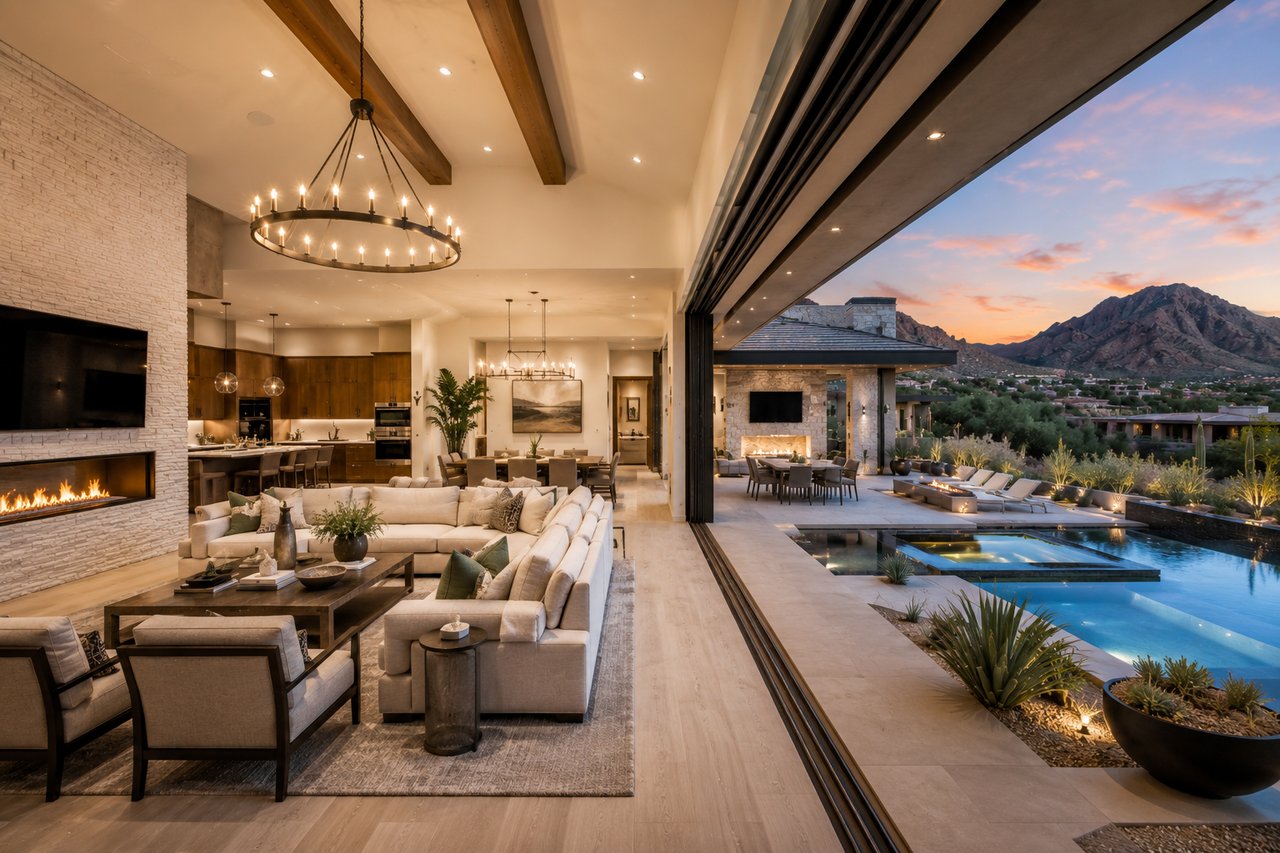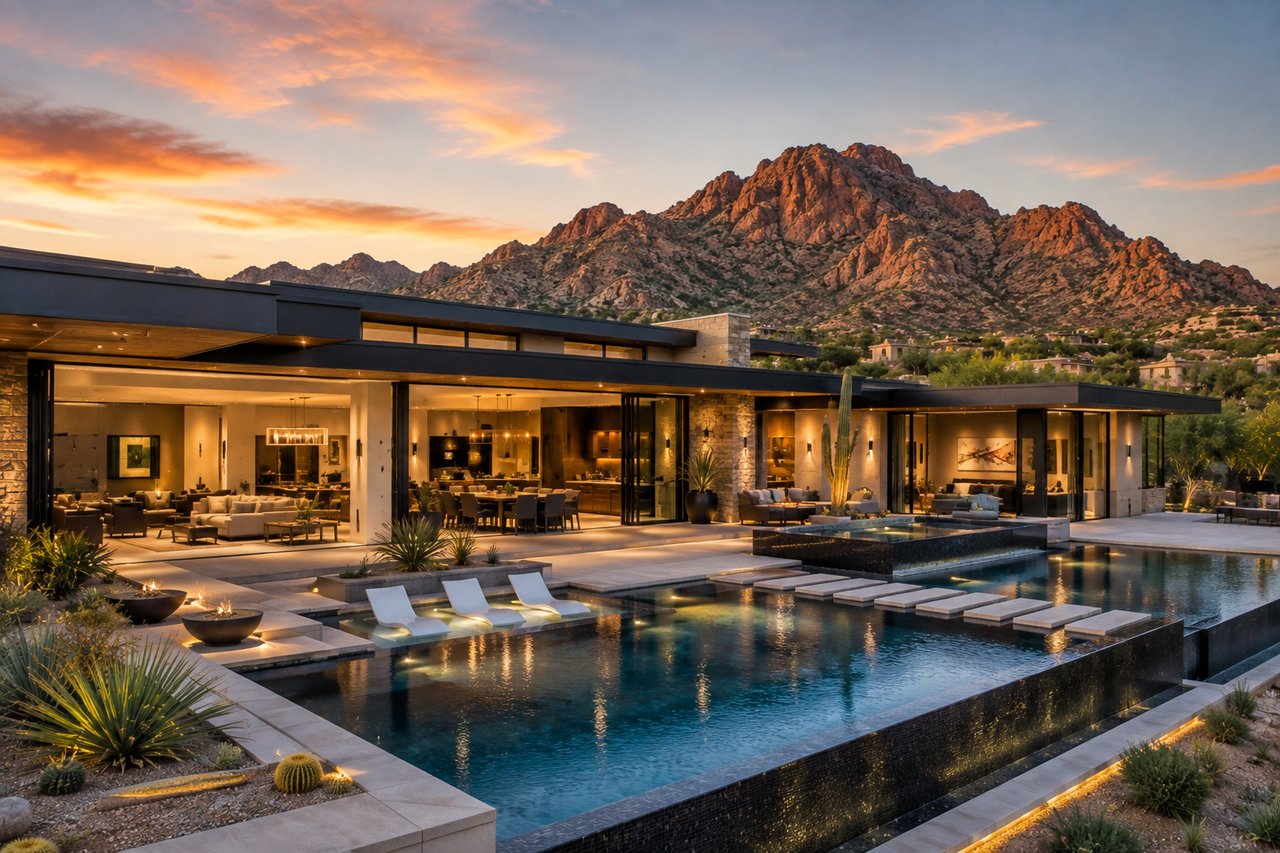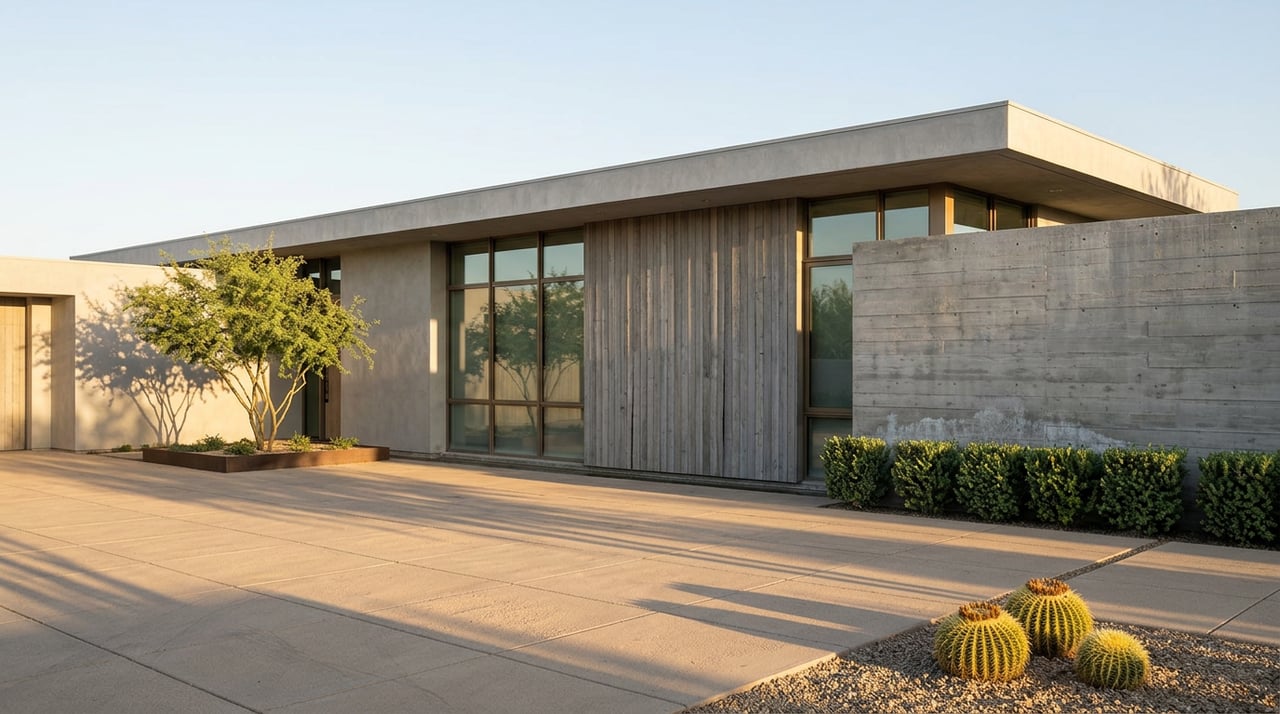
Search "Paradise Valley median home price" this week and one home value tool tells you $3.58 million. Click through to a national listing site and the median list price reads closer to $5.5 million. Look up the Institute for Luxury Home Marketing's benchmark figure for the same zip code and the number drops to $1.7 million. None of these sources made an error. They are describing a market that behaves less like a typical housing market and more like a small auction house, where twenty or thirty closings in a month can swing the headline number by hundreds of thousands of dollars depending on which particular estate happened to trade.
That is the real story unfolding in Paradise Valley right now. The median is not a fixed price you can shop against. It is a snapshot of whichever two or three homes closed inside a given site's counting window, and if you are house hunting here with a single number in your head as your compass, that compass is spinning.
Five Sources, Same Zip Code, Five Different Answers
As of mid September 2026, here is what a buyer researching the town's single zip code, 85253, actually finds:
| Source | What it measures | Figure | Window |
|---|---|---|---|
| Home value index | Typical home value | $3.58 million, up 11.2% year over year | Through June 30, 2026 |
| Rolling sale-price tracker | Median sale price, three-month rolling | $4.6 million | Three months ending April 2026 |
| National listing aggregator | Median list price | $4.99 million to $5.5 million | May through June 2026 snapshots |
| Institute for Luxury Home Marketing | Luxury-segment benchmark price | $1.7 million | January 2026 report |
| Live MLS feed | Median list price, active inventory | $5,488,888 | September 14, 2026 |
Notice what each row is actually asking. A median list price answers a different question than a median sale price, and both differ from a typical-value estimate that averages every home in town whether it changed hands this year or not. The ILHM figure is lower still because it marks the entry point into what that organization classifies as the luxury tier, not the center of the market. Five legitimate methods, five legitimate numbers, one town.
Why the Number Won't Hold Still
The instability comes down to volume. In the three months ending April 2026, 103 homes closed in Paradise Valley, down slightly from 108 the year before. The Institute for Luxury Home Marketing's December 2025 snapshot counted just 22 luxury sales for the entire month. When your sample size is measured in dozens rather than hundreds, one outsized transaction reorders the math for everyone tracking it.
In July 2026, a single Paradise Valley estate reportedly sold for $40.24 million, according to Phoenix Business Journal reporting, the largest residential sale on record in Arizona. A closing that size landing in a thirty-home month does not just nudge the average upward. Depending on where it falls in the sorted list, it can decide whether that month's median reads above or below five million dollars entirely on its own.
Compare that to a high-volume submarket like Scottsdale or greater Phoenix, where hundreds of homes close every month and one large sale barely moves the needle. Paradise Valley does not have that scale to absorb outliers. The town closes roughly forty to sixty homes in an active month, and each one carries enough individual weight to swing the figure that gets rounded down to a single headline.
The One Acre Rule That Built Two Markets Inside One Town
The deeper reason the median resists a clean answer is zoning, not statistics. Paradise Valley incorporated in 1961 specifically to preserve large lot residential character against annexation pressure from Phoenix and Scottsdale. The town's zoning ordinance still reflects that founding purpose. The base single family district, R-43, requires a full acre per home. The largest residential district, R-175, requires more than four acres. There is no small lot subdivision zoning here the way there is across the border in Phoenix or Mesa.
That single rule is why "what's the median home price" does not have one honest answer. A town built entirely on large lots with no tract-builder product naturally splits into two markets that trade almost independently: land value and structure value. A dated mid-century ranch on a flat acre in the Camelback Country Estates and Cherokee corridor can sell primarily for what a buyer plans to build after the existing house comes down. A brand new estate two streets over, on a comparable lot, can trade for four times as much because in that case the structure is the product being sold. Both transactions land in the same "Paradise Valley home price" pool that portals average together.
What Your Money Actually Buys, Tier by Tier
Once you separate the two markets, the pricing logic gets much clearer. Teardown land in Paradise Valley currently trades in the $2 million to $3 million range for the lot alone. Pair that with a $5 million to $7 million custom build and the finished asset lands around $8 million to $12 million, a tier below the $15 million-plus trophy segment where architectural pedigree and irreplaceable view corridors drive the price. Demand for organic modern architecture in that same Camelback Country Estates and Cherokee pocket has been rising through 2026, which is part of why teardown land there commands a premium over comparable acreage elsewhere in town.
For buyers who want the address without maintaining a full acre, gated enclaves like Azure at Ritz-Carlton, Paradise Reserve, and Cameldale Estates offer concierge-style, lock-and-leave living inside the town boundary. These communities exist precisely because not every buyer wants the upkeep that comes with the zoning code's minimum lot requirement, and they represent one of the only ways to buy new construction in Paradise Valley without also buying an acre of land to go with it.
The teardown side of the market produces its own quirks. One active listing this year offered a 73,180 square foot lot with an 18,000 square foot building envelope, structured so the buyer could collect rental income on the existing 6,600 square foot house while a new design worked through the town's permitting process. That arrangement only makes sense in a market where the land underneath the house is the primary asset. Hillside parcels add another layer of friction: any project on sloped ground goes through the town's Hillside Building Committee, which reviews grading, drainage, height, and building materials before a permit moves forward, a review step that flatland lots in the same town simply do not face.
The Question Worth Asking Instead
Chasing the median in Paradise Valley is chasing a number that was never built to hold still. The more useful question is which of the three tiers your budget actually lands in, teardown land, mid-tier rebuild, or trophy new construction, and what comparable properties in that specific tier and that specific pocket of town closed for in the last few months. A portal's rolling three-month average cannot tell you that. A close read of recent, like-kind closings can.
A Few Questions Worth Settling Upfront
Why is the Institute for Luxury Home Marketing's number so much lower than everyone else's? Because that $1.7 million figure marks the entry point into what ILHM classifies as the town's luxury segment, not the center of the market. It is a floor, not a median in the way most buyers use the term.
Is Paradise Valley a buyer's market right now? Days on market have widened across most trackers through 2026, ranging from roughly 69 to 97 days depending on the source and window, and some methodologies have labeled the segment balanced at points this year. That gives serious buyers more room to negotiate than they had two years ago, though sale-to-list ratios still cluster in the mid-90s, meaning realistically priced homes are still closing near asking.
Is Paradise Valley High School actually located in Paradise Valley? No. Despite sharing the name, Paradise Valley High School, Paradise Valley Community College, and Paradise Valley Mall all sit several miles north in Phoenix. The town itself is confined to a single zip code, 85253.
If you are trying to figure out which tier of this market actually fits your plans, a number pulled from a portal will not settle it. A conversation grounded in recent, comparable closings will. Hague Luxury Network works this exact zip code every week and can walk you through what a specific lot, corridor, or teardown opportunity is realistically worth right now. Request a confidential consultation and we will build the comparison around your actual price point, not a rolling average.